
Beyond Listening Series: Stepping out of the Script
Reclaiming attention, reshaping meaning, and choosing how we respond—together
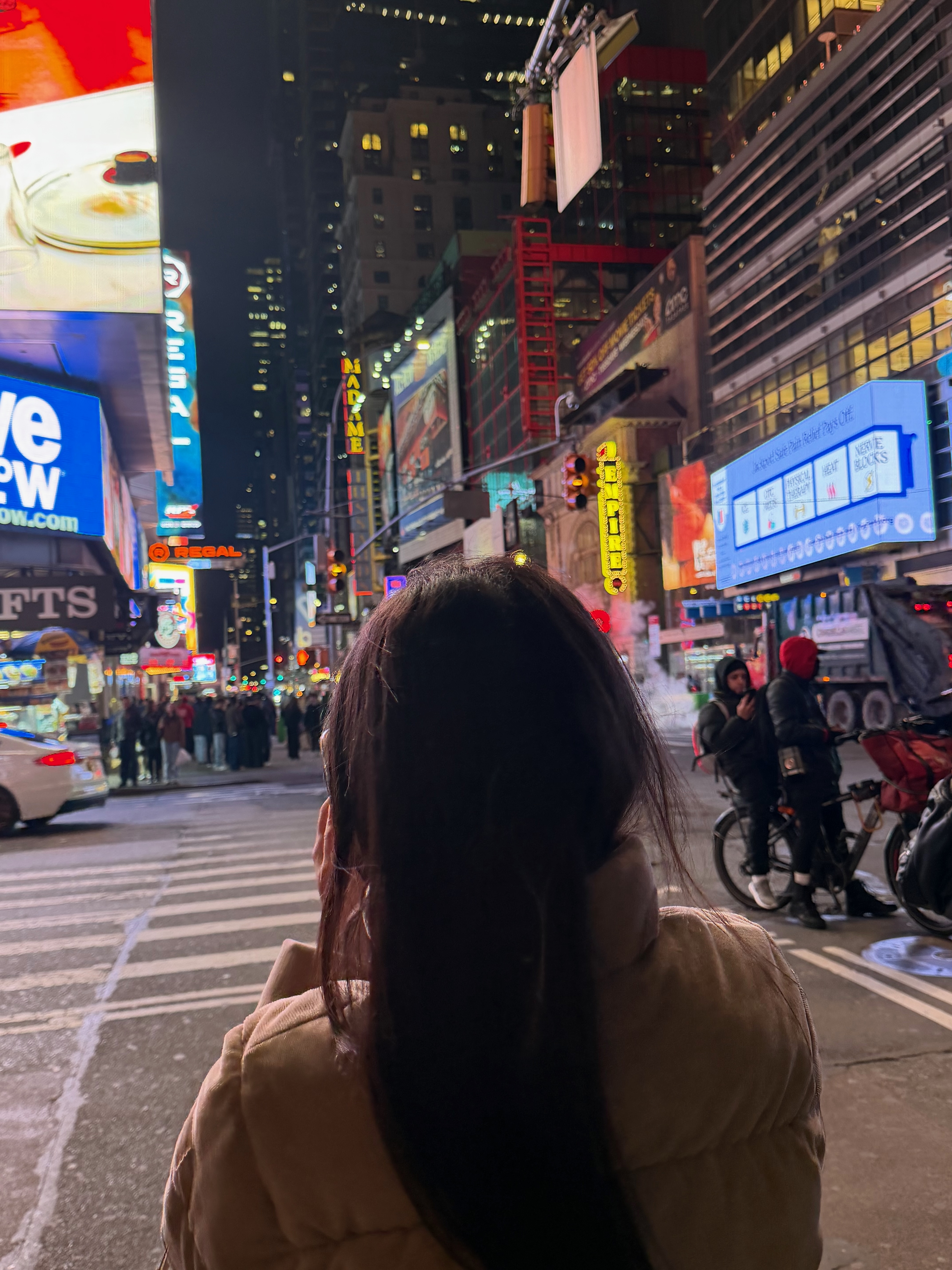
I’m writing this from New York, which feels like a heightened, almost physical expression of the competition for attention. Here, it’s no longer abstract—it’s embodied, everywhere you look. Times Square, especially, feels like a kind of performance art piece; an offering, or perhaps an effigy, to something vast and chaotic: signals streaming from every direction, layering and colliding, more than any one mind can hold. Everywhere, something is asking to be noticed.
A screen. A siren. A headline. A conversation at the next table. Ads designed to meet unmet desires that were never meant for the marketplace.
News designed to feel like an emergency.
Opinion dressed up as certainty.
Certainty dressed up as truth.
The sheer force of it can make attention feel less like a human capacity and more like contested territory. Almost a war for the space to take the next breath—and inhabit the stillness where signals are received, distilled, and meaning takes shape. Often I find myself holding my breath, or walking the streets directing my attention with the sole purpose of shutting things out. Narrowing the field. Looking down. Moving quickly. Deciding, over and over again, what not to let in. Creativity begins to feel like a commodity, and the effort to refine, illuminate, and communicate starts to feel futile: how could it be heard amidst all the noise?
As a practice, I keep returning to a questions:
What am I making this mean?
Who is orchestrating that meaning?
Because the world does not arrive to us as pure fact. It arrives through perception. Through interpretation. Through memory, mood, conditioning, longing, fear, and desire. We are not simply seeing reality; we are participating in it, constantly shaping it individually and collectively through the meanings we assign.
I’ve been thinking about this through the lens of Ed Yong’s An Immense World, which explores the radically different ways other creatures perceive their environments. A turtle sensing magnetic fields. A fish detecting electrical signals. A bee seeing patterns in flowers we cannot see. Each creature inhabits its own sensory world, its own umwelt. It is a humbling idea.
What I experience as “the world” is not the world in any complete sense. It is one version of it. A human version. Along with a unique perspective shaped by each of us.
The expression of that is filtered through culture and shared agreement. We see a certain wavelength and call it red. We agree it is red, and so it becomes part of consensual reality. It lives in shared language—quietly revealing where we place our attention, and how.
Where there is this underlying assumption that is shared - that agreement matters. We need shared meaning in order to live together. But it also raises an important question: if so much of our world is shaped by interpretation, then what happens when the processes by which we make meaning are distorted, fragmented, accelerated, or colonized by forces competing for our attention? When the conditions for meaning-making are constantly being manipulated?
Because it is not only that there is too much information. It is that there are too many ready-made interpretations. Too many scripts waiting for us before we’ve had a direct sensory experience of our environment. Before we’ve had time to receive our own response, voices are already there telling us what this means, who is right, who is wrong, who to blame, what to fear, what side to take. We are offered conclusions at the speed of impulse.
And when that happens often enough, we begin to lose touch with something essential: the difference between reality and our interpretation of it.
I notice this most clearly in ordinary human moments. Have you ever left a conversation wishing you had responded differently? Maybe it was a meeting, an argument, or an exchange with someone you love. In the moment, your response felt obvious, even necessary. Only later did something else become visible. You realized you weren’t only responding to what was happening right there in front of you. You were responding from inside a pattern. A story. A role. A familiar script.
The script had arrived faster than awareness.
This happens all the time. Certain roles emerge quickly: the fixer, the critic, the peacemaker, the authority, the outsider, the one who always carries the emotional weight, the one who withdraws before they can be hurt. Most of the time, no one consciously chooses these roles. They arise from history, from context, from accumulated experience, from subtle signals people send and receive without realizing it.
Once those roles take shape, the interaction can begin to feel inevitable.
But it isn’t inevitable. It is patterned.
And this can be where the possibility of freedom begins. Human beings have a remarkable capacity: we can witness ourselves while we are in the middle of experience. We can notice the script without immediately obeying it. That doesn’t mean we become detached or above it all. It means we become slightly less fused with our first interpretation. We create a little space between stimulus and response. Enough space, perhaps, to ask a different question.
What story have I stepped into?
What else might be true?
That movement matters because our meanings don’t stay private for long. They become relational. They shape tone, posture, policy, culture, and collective life. They affect what a group can see and what it cannot see. They influence whether difference becomes wisdom or threat. In that sense, collective reality is not simply something we inherit. It is something we are constantly helping to produce.This is why I keep returning to attention. Because attention is not neutral. What we attend to grows in significance. What we repeat becomes familiar. What is familiar begins to feel true. And what feels true begins to organize our world.
If our attention is continually captured by outrage, speed, performance, and fear, then those forces will begin to shape not only our individual nervous systems but our shared reality. We become more reactive, more certain, more brittle with one another. We will mistake immediacy for truth. Volume for clarity. Consensus for wisdom.
But another possibility remains available.
We can practice noticing.
We can slow down enough to become aware of how meaning is forming in us. We can become more curious about perception itself. We can ask what has shaped our interpretation before we act from it. We can widen the frame enough to include context, history, emotion, embodiment, and relationship.
And groups can do this too.
When a group pauses long enough to notice what is happening beneath the content of a conversation, something often shifts. What looked like conflict may turn out to be grief. What looked like resistance may be fear. What looked like confusion may actually be a wise refusal to collapse complexity too quickly. This kind of pause is not passive. It is an act of reorientation.
It helps us step out of inherited scripts and re-enter relationship with what is actually here. Developing this capacity individually and collectively is becoming essential if we are to find our way in the attention economy. Not to stop making meaning, that is impossible. Meaning-making is part of being human. But to be more conscious of how we are doing it. To notice when our interpretations are being driven by fear, urgency, or social contagion. To remember that our view is always partial. To hold our reality with a little more humility.
Maybe this is where wisdom begins.Not in certainty, but in the willingness to question the frame. Not in having the right story, but in recognizing that we are inside one. Not in stepping outside human experience altogether, but in becoming more awake within it. So this is the question I’m carrying right now:
What kind of collective reality are we helping create by the way we pay attention, by the meanings we rush to make, and by the stories we are willing—or unwilling—to question?
I don’t think there is a simple answer. But I do think the first step is to notice the script, both individual and collective. And then, gently, to step to its edge long enough to choose again. To place our attention, with care, on the reality we are shaping together.
Because we are always, in some way, participating in what comes next.
Send me the latest blog post

More posts
The Shadow of Transformation
Beyond Listening Blog Series: Making Meaning in Seasons of Change

Beyond Listening Series: The Thin Line Between Collective Wisdom and Collective Folly

Beyond Listening Series: Agency and Communion

Stay in Touch
Sign-up for the Open Circle newsletter to receive updates on upcoming classes, events, and much more.


